How the House Edge Works - And How Rakeback Fights It
Deep dive into casino house edge and how it's calculated. Learn how rakeback mathematically reduces your effective house edge and turns losses into profits.
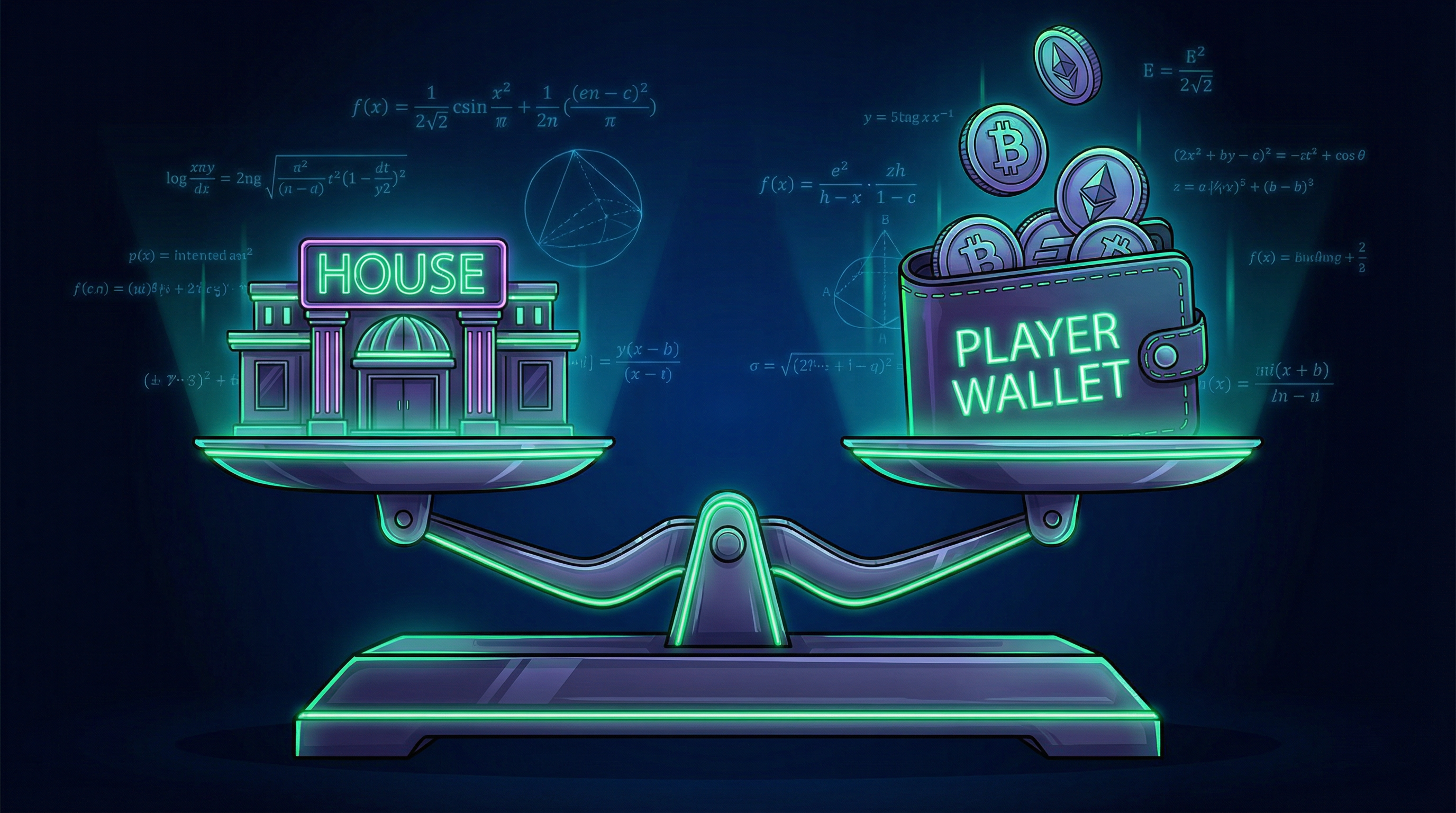
The house edge is the fundamental reason casinos are profitable and players face long-term losses. Understanding it isn't depressing - it's liberating. Once you know how the rake works, you can use rakeback to mathematically reclaim significant value.
This guide explains the math behind the house edge and shows you exactly how rakeback transforms the casino economics in your favor.
What Is the House Edge?
The house edge is the statistical advantage the casino built into every game. It's expressed as a percentage that represents the casino's expected win over time.
Simple definition: If a game has a 2% house edge, the casino expects to win $2 for every $100 wagered, over the long run.
This is different from short-term variance. In 100 spins of roulette, you might win big. But play 10,000 spins, and the house edge becomes mathematically inevitable.
The house edge is NOT:
- The amount you'll lose on your first bet
- A fixed loss amount
- Something that changes based on your luck
- A mathematical probability
- The casino's expected profit margin
- Consistent across millions of wagers
How the House Edge Is Built Into Games
American Roulette
The Setup: 38 slots (numbers 1-36, 0, 00). You bet $1 on black.
The Math:
- 18 of 38 slots are black
- Probability of winning: 18/38 = 47.37%
- Casino should pay 1:1 odds (your $1 bet wins $1)
- Payout should mathematically be: $1 × (18/38) = $0.4737
- Casino pays exactly 1:1 odds
- You get $1 if you win, $0 if you lose
- Expected value: $1 × 0.4737 = $0.4737
- Expected loss per $1 wagered: $1.00 - $0.4737 = $0.0526 = 5.26% house edge
Blackjack
The Setup: Standard deck, standard rules.
House Edge: 0.5% to 1.0% (varies by rule variations)
Why? Subtle advantages:
- Players bust first (they play before dealer)
- Dealer doesn't bust on 21 (player already lost)
- Insurance bets heavily favor house
- Slight dealer positional advantage
Slots
House Edge: 2% to 15% (varies widely)
Why? RTP (Return to Player) is built into the software. A slot with 96% RTP has a 4% house edge.
- Game 1: 96% RTP = 4% house edge
- Game 2: 98% RTP = 2% house edge (better for you)
Poker
House Edge: 0% to 2.5% (rake-based, not house edge)
Why? Poker is player-vs-player. The house edge comes from rake:
- Rake per hand: $1-$5
- Rake percentage: 2.5%-5% of pot
- Tournament fee: 10% of buy-in
House Edge by Game - Comparison Chart
Why Casinos Always Win Long-Term
The Law of Large Numbers
With small sample sizes, luck dominates. Flip a coin 10 times, you might get 7 heads. But flip it 10,000 times, and you'll be very close to 5,000 heads.
Similarly:
- Play 10 roulette spins: You might win big from luck
- Play 10,000 roulette spins: You'll have lost ~5.26% of your wagers to the house
The house edge isn't a suggestion - it's built into the game mathematics. A casino with millions of players wagering billions is mathematically guaranteed to win that edge percentage.
Your Expected Loss
Here's the uncomfortable truth:
- $10,000 wagered at blackjack (0.5% house edge) = -$50 expected loss
- $10,000 wagered at American roulette (5.26% edge) = -$526 expected loss
- $10,000 wagered at slots (5% average) = -$500 expected loss
The Poker Rake Example
Poker is unique because it's player-vs-player, but casinos still profit through rake.
Example hand:
Player A bets $100. Player B bets $100. Casino rakes 5%.
- Pot total: $200
- Casino rake: $200 × 5% = $10
- Winning player gets: $190
- You play $10,000 in poker hands
- You win 55% of your sessions (you're good!)
- Casino still takes 5% rake on every hand
- Expected rake paid: $500 (regardless of your 55% win rate)
How Rakeback Mathematically Reduces Your House Edge
Now here's the game-changer: rakeback returns a percentage of the rake you paid.
The Math of Rakeback
Without rakeback:
- Wagers: $10,000
- House edge (slots): 5%
- Expected loss: -$500
- Wagers: $10,000
- House edge (slots): 5% = -$500
- Rakeback earned: $10,000 × 10% = +$1,000
- Net result: +$500 (profit!)
- Wagers: $10,000
- House edge: 5% = -$500
- Rakeback earned: $10,000 × 20% = +$2,000
- Net result: +$1,500 (significant profit!)
Your Effective House Edge With Rakeback
Here's the formula:
Effective House Edge = (House Edge %) - (Rakeback %)
Examples:
| Game | House Edge | Rakeback Rate | Effective House Edge | Status |
|---|---|---|---|---|
| Slots | 5% | 0% | 5% | Losing |
| Slots | 5% | 10% | -5% | Winning |
| Slots | 5% | 15% | -10% | Winning |
| Blackjack | 0.5% | 10% | -9.5% | Very Winning |
| Roulette | 2.7% | 5% | -2.3% | Winning |
| Roulette | 2.7% | 15% | -12.3% | Very Winning |
Real-World Rakeback Examples
Example 1: Casual Slots Player
Monthly play: 30 hours Average wager per hour: $50 Monthly total: $1,500
Scenario A - No Rakeback:
- House edge: 5%
- Monthly expected loss: $1,500 × 5% = -$75/month
- Annual loss: -$900
- House edge: 5% = -$75/month
- Rakeback earned: $1,500 × 10% = +$150/month
- Monthly result: +$75
- Annual profit: +$900
Example 2: Serious Player
Monthly play: 100 hours Average wager per hour: $200 Monthly total: $20,000
Scenario A - Traditional Online Casino (1% loyalty):
- House edge: 4% (average across games)
- Expected loss: $20,000 × 4% = -$800/month
- Loyalty: $20,000 × 1% = +$200/month
- Monthly result: -$600
- Annual loss: -$7,200
- House edge: 4% = -$800/month
- Rakeback: $20,000 × 20% = +$4,000/month
- Monthly result: +$3,200
- Annual profit: +$38,400
Why Different Games Have Different House Edges
Game designers use three levers to create house edge:
1. Payout Odds
Roulette's 5.26% house edge exists because the payout odds don't match true probability. The casino intentionally underpays.
2. Probability Design
Slots are programmed with an RTP percentage. A slot with 96% RTP will mathematically return 96% and keep 4%.
3. Rake Structure
Poker/poker-variants use rake instead of house edge. Casino takes a percentage of each pot.
The Variance Factor: Why Short-Term Results Vary
The house edge is a long-term mathematical certainty, but short-term results vary wildly due to variance.
Why this matters:
- Luck dominates short-term play
- House edge dominates long-term play
- Rakeback gives you an edge regardless of luck
How Rakeback Guarantees Value
The beautiful part about rakeback is that it's volume-based, not luck-based.
Whether you win or lose your bets:
- You earn rakeback on your wagers
- It pays out regardless
- It compounds over time
FAQ
Q: Does house edge apply to poker? A: No - poker is player-vs-player. Instead, casinos take "rake" (a percentage of each pot). Rake has the same mathematical effect as house edge.
Q: Can I overcome the house edge through strategy? A: Only in games like blackjack and poker where skill matters. Slots and roulette are purely random - strategy doesn't help. But rakeback helps in all games.
Q: Is the house edge the same everywhere? A: No. A blackjack game might have 0.5% edge at one casino and 1.2% at another (due to rule variations). Always compare house edge percentages.
Q: How is RTP different from house edge? A: RTP (Return to Player) and house edge are inverse. A 96% RTP = 4% house edge. Higher RTP is better for you.
Q: Can rakeback make any game profitable? A: Mathematically yes, if rakeback % exceeds house edge %. Practically, yes for slots and roulette. For table games, rakeback is lower but can still reduce your effective house edge significantly.
Q: Why don't all casinos offer rakeback? A: Traditional regulated casinos have licensing restrictions that make rakeback difficult. Crypto casinos operate with fewer restrictions and can offer it competitively.
Q: Is rakeback guaranteed to make me a winner? A: Rakeback guarantees a percentage return on wagers, but you could still lose money if your wagers exceed the rake value. Example: 10% rakeback on $10,000 = $1,000 earned, but if you lose $2,000, you're still -$1,000 net.
Q: How much rakeback should I aim for? A: Aim for rakeback ≥ house edge. Example: If you play slots (4% edge), target 5%+ rakeback to be profitable long-term.
Q: Does rakeback count toward wagering requirements? A: Typically no. Wagering requirements apply to bonus funds, not rakeback. Rakeback is yours to keep.
Q: Can I combine rakeback with bonuses? A: Yes! This is how you maximize value. Claim a bonus AND earn rakeback on the wagers that clear it.
Q: Is higher house edge always bad? A: Not if rakeback is higher. American roulette has 5.26% edge, but with 10% rakeback, it becomes -4.74% (you're winning).
The Rakeback Advantage: A Summary
The house edge is casino mathematics made inevitable through volume. But rakeback inverts the equation.
Without rakeback:
- You're mathematically certain to lose money long-term
- 5% house edge = -$500 per $10,000 wagered
- You can turn losses into profits
- 5% house edge - 10% rakeback = +$500 per $10,000 wagered
- Your effective edge becomes positive
Ready to flip the math in your favor? Join RakeDaddy today to access the best rakeback deals available. Compare rates across top crypto casinos and turn your wagers into guaranteed returns.
The house always wins without rakeback. With rakeback, you do.
Ready to Start Earning Rakeback?
Sign up for free and start collecting crypto on every bet you place.
Create Free Account →